
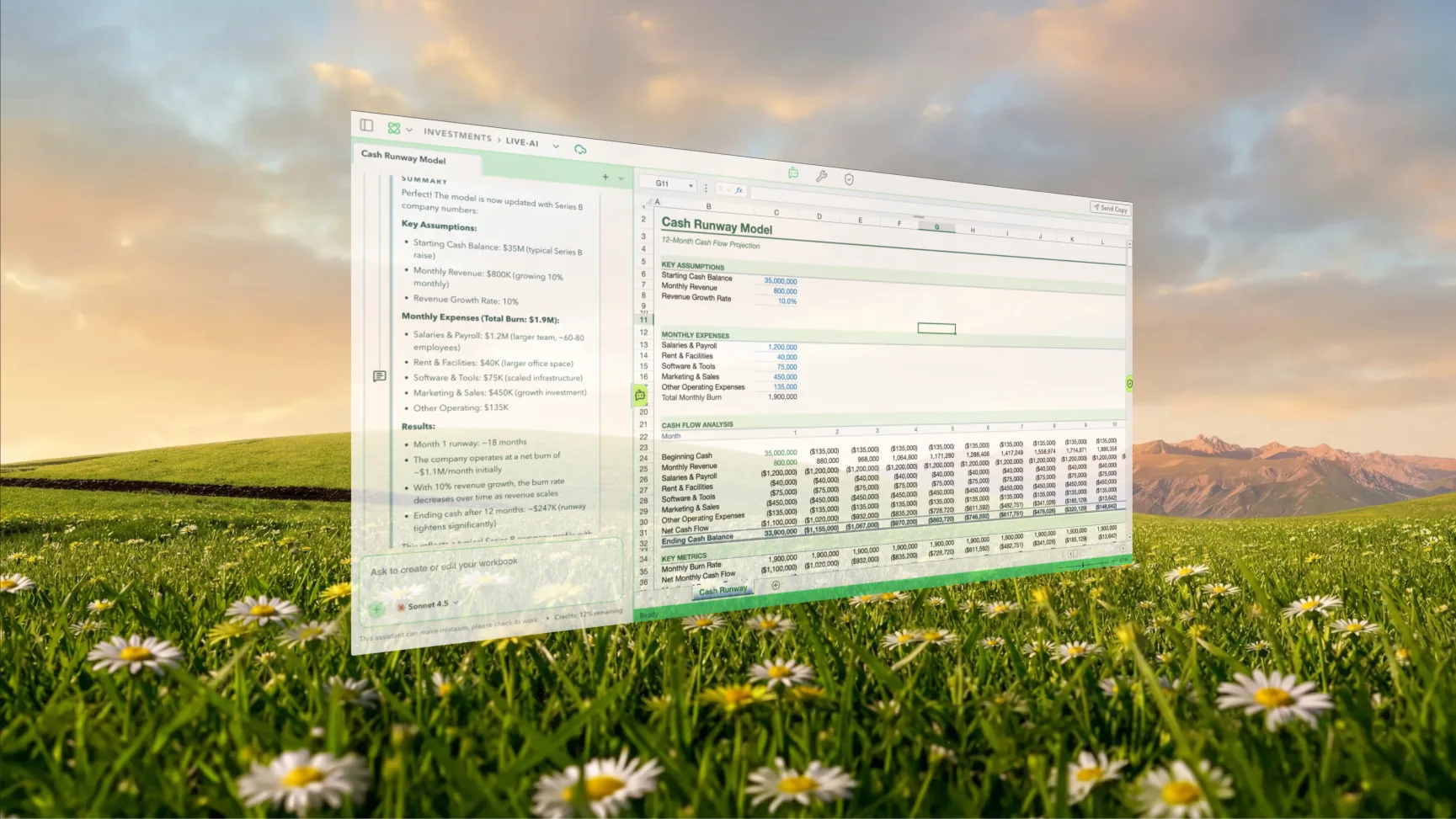
AI changes what's valuable
AI lets professionals trade grunt work for higher-value insight. It also gives people who can't afford a professional the tools to handle the basics themselves.
That raises an obvious question: if AI can do the work, why do you still need the professional?
What AI has actually commoditized is generic knowledge, not the judgment, taste, or method an expert uses to approach a problem.
That makes a professional's unique way of working, their professional IP, worth more, not less. Once it's captured and embedded into AI, it becomes an asset they can use to serve more people. Without it, a generic model just gives everyone the same average output.
Over the past few months, I've talked to many finance professionals. They tell me the same thing: today's tools get them about 70% of the way there, and the last 30% takes forever. AI is useful for a back-of-the-envelope analysis or a first draft, but it's not reliable enough yet for a real deliverable where the output needs to actually reflect a business's own logic, standards, and judgment.
That's the gap Atomiq is working to close.
Why skill files alone don't close the gap
The current fix is the skill file: a set of written instructions, or a long prompt you reuse repeatedly that's supposed to teach the AI your best practices and routine work.
Skill files are useful for simple tasks and context management. But they are still a probabilistic system, and we have started relying on them to produce results we expect to be applied consistently every time.
Picture a new hire joining your team. You wouldn't hand them a single Word doc and expect them to nail your formatting and structure across a spreadsheet or a presentation. In a complex workbook, written instructions cannot efficiently capture every formula pattern, structural convention, formatting rule, and exception. And if you actually tried, writing the instructions would take longer than building the thing yourself. Instead, you'd give that new hire examples of past projects they can review and copy from directly.
Because a skill file does not contain enough detail to get you to real precision, the model fills those gaps using patterns from its general training rather than your actual best practices. That pushes your output toward a mean of mediocrity. Some call it “AI slop.”
What’s missing is sufficiently rich context and a more deterministic way for the agent to reuse trusted work, apply it consistently, and make only the changes the task requires.
Atomiq helps the agent, like you would help a new hire—showing it the full context of your past work in a format it can reason about and make targeted edits to. It's leveraging the work itself, not a description of it.
Why spreadsheets struggle with AI
Spreadsheets have over a billion users globally and sit at the center of the decisions that shape a business. Most companies are sitting on serious spreadsheet debt: critical business logic stored in a format that's genuinely hard for an agent to reason over. In the AI era, high-quality context about your business is the most valuable asset you have, and a low-context spreadsheet is a major liability.
Three specific problems make spreadsheets challenging for agents:
Lack of semantics, an accuracy problem. When an agent reasons over code, it has named identifiers, data types and structures to improve comprehension. With spreadsheets, it has relative references. Almost no one names every value and range. This dislocates meaning from logic. You feel this problem as the agent getting confused or failing to relink correctly during a large structural change.
Relative references, a cost problem. Because business logic lives in relative references, it shifts as the grid is restructured, forcing the agent to keep rereading large portions of the file to refresh its understanding. You may have noticed that the agent does very well going from zero to something, then loses its place across consecutive edits. If you've burned through tokens quickly using AI in Excel, this is one of the reasons why.
Poor auditability. Spreadsheets hide their logic and changes. They've always been hard to audit—there is an entire industry for auditing spreadsheets. If we're going to generate at 10x the speed, we need tools that help us audit and build confidence faster too, or else we've just created a new bottleneck.
How this should work
When you prompt the agent for a new task, it finds similar work you’ve already done. It might retrieve a prior scenario manager or a project from three months ago that you tagged as a strong example of cohort analysis. It reuses trusted formula logic while making clear what came from prior work and what was generated by AI. The goal is to reduce how much trusted work you need to re-check, shrinking the review surface and speeding up both generation and verification.
Atomiq's approach
Atomiq's first product has three core focuses.
Applying your best practices. Your past work shows the agent how you approach a task. It applies what you've already established and adapts where something is genuinely new. It’s designed to keep the output recognizably yours, and the knowledge behind it organized and reusable, rather than locked in your head or buried in one-off files.
Solving the validation bottleneck. An agent can make a lot of changes fast, and you're still fully accountable for the numbers. Atomiq surfaces material changes an agent makes and can preserve explicit links between data points and their sources. The model can reason about the task, but change tracking and source lineage should not depend on the model remembering or explaining what it did. Your confidence comes from seeing every change the agent made.
Delivering low-cost, abundant intelligence. Atomiq’s harness can run on multiple frontier models, and we are actively building support for open-weight models. Our focus is creating a more token-efficient, machine-readable architecture for representing spreadsheet data, ensuring every task is completed accurately with as little token spend as possible.
Who Atomiq is for
I left a traditional career because I wanted more ownership over my work. I’ve met many people since who made the same decision. They are fractional CFOs, founders of professional-services businesses or operators building startups with teams that would've been impossibly small a few years ago. They see AI as a way to take real ownership over their professional lives.
These are the people we're most excited to serve first: fractional CFOs running a growing portfolio of clients, and small-business finance teams who live in spreadsheets for planning, reporting, and the administrative weight of running a business. Many of them have spent years developing their own way of working: how a model should be structured, which assumptions stay visible, what “good” looks like for a given deliverable. Those judgments may feel routine to them by now, but they are built from years of experience.
We think AI turns that judgment into an asset. It lets everyone delegate the routine execution while keeping full control over the standards behind it.
To be clear: we're starting here because it's where we can deliver value the fastest. But knowledge work everywhere has the same problem. Most of the time goes to prep: pulling numbers, rebuilding the same model, checking that nothing's wrong. The actual judgment call happens in whatever time you have left. If an agent does the prep, it's not that you are doing less work; you're doing more of the part that matters.
Why now?
Timing matters as much as an idea.
Building for the application layer at the start of a technology shift is punishing: what's possible expands every few months, the right approach keeps changing, and you spend your time compensating for limitations the next model generation will simply erase.
That was 2023 and 2024. Models were moving fast, but reliability across real professional workflows wasn't there yet, so demos looked impressive without translating into real business value. By 2025, model capability had improved, but inference cost remained a serious constraint for many application-layer companies.
In the first half of 2026, the equation changed. The frontier models are powerful enough for many knowledge work tasks, agentic infrastructure has matured, and costs may finally come down thanks to pressure from open-weight models. I think the next three years will produce great companies at the application layer. The open challenge now isn't model capability. It's closing the ROI gap: turning that capability into reliable business value at a price that makes sense.
Coming next
Our private beta is open.
If personalization, accuracy, and cost are what you care about in an AI product, you can join our waitlist.